
Bill Book Printing Guide: GST Format, Size, Design, Paper & Price
Bill Book Printing Guide: GST Format, Size, Design, Paper & Price
Last Updated: 10 August 2026
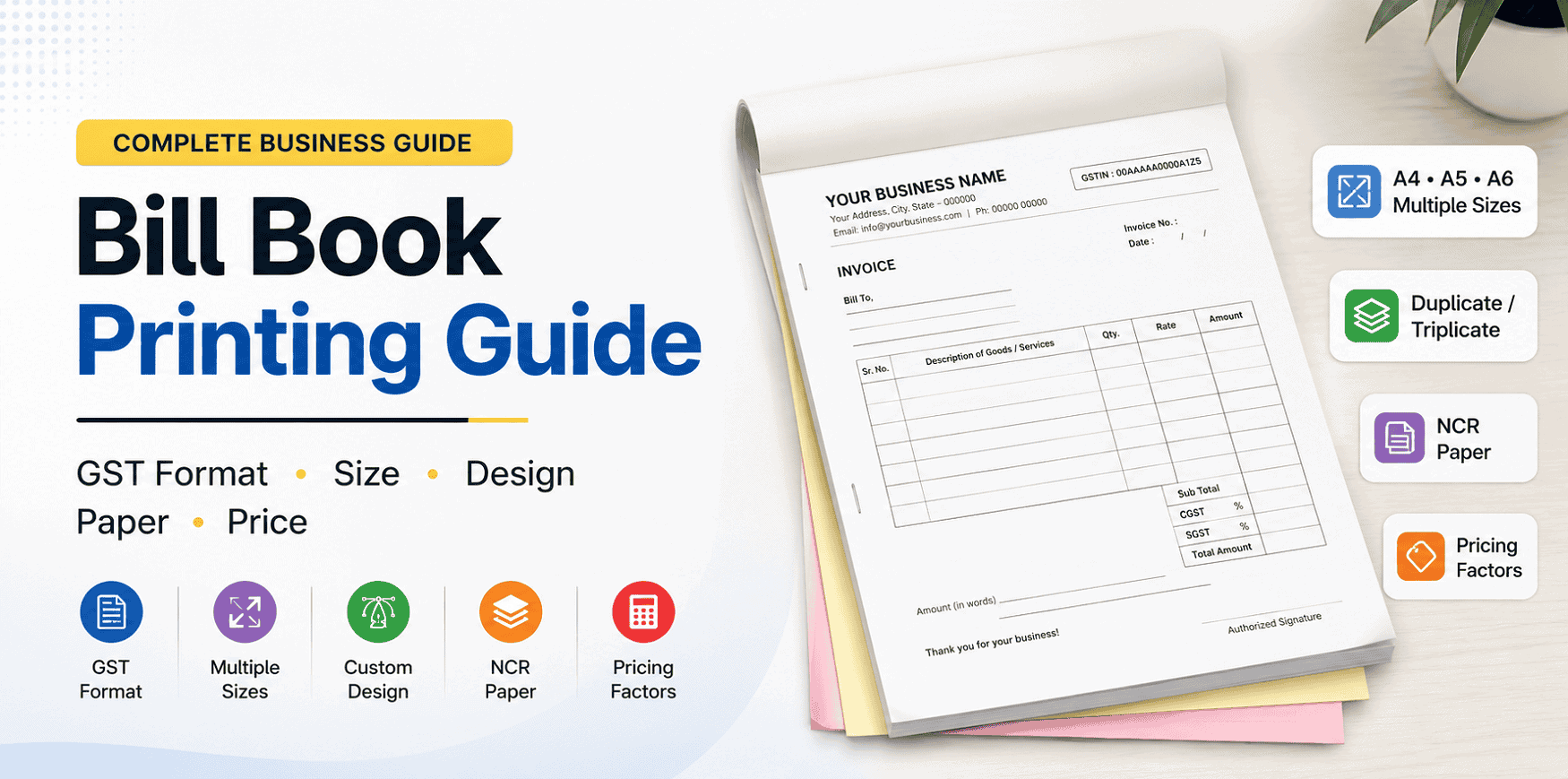
A bill book looks like a simple booklet. But the size, copy format, field layout and writing space decide how easy billing feels every single day. A design that looks good on screen can still slow down a counter if there is no room to write a customer name or item description.
That is why it helps to understand the basics before ordering. The right bill book format depends on what information each invoice needs, how many copies your business must retain and where the billing actually happens.
Key Takeaway: There is no single best bill book for every business. A single-copy book suits simple receipts, a duplicate book suits a customer-plus-office workflow, and a triplicate book suits businesses that need three separate records. Size and layout should follow the way your staff actually write bills.
Need custom bill books for your business? Explore Tagsen's custom bill book printing options.
What Is a Bill Book?
A bill book is a printed booklet used to manually record and issue invoices, bills, cash memos or receipts. It usually contains predefined fields for the business, customer, transaction, invoice number, date, item or service description, quantity, rate, tax and total amount.
An invoice generally provides a detailed record of goods or services supplied and the amount payable, while a receipt is commonly used to acknowledge a payment or completed transaction. The exact document required depends on the nature of the transaction and applicable business or tax requirements.
A customised bill book can also include a company logo, address, contact details, GSTIN, invoice numbering and branded layout.
For businesses that mainly need payment acknowledgements rather than detailed invoices, a cash voucher book may be more suitable than a full invoice-book format.
Why Do Businesses Use Printed Bill Books?
Why are bill books useful for small businesses?
Printed bill books provide a straightforward way to create physical transaction records. They can be particularly useful when billing is completed manually, during field visits, at delivery locations or as a backup when a digital billing system is unavailable.
They can also help businesses maintain organised records while giving customers a clear physical copy of a transaction.
Common uses include:
- Offline billing
- Counter sales
- Field sales
- Delivery transactions
- Service visits
- Manual record keeping
- Backup billing
- Customer receipts and invoices
A professionally designed bill book for business can also carry consistent branding instead of relying on plain or handwritten sheets.
Which businesses commonly use bill books?
Printed bill books can be useful for many types of businesses, including retail shops, wholesalers, distributors, hardware stores, jewellery stores, restaurants, repair businesses, service providers and local traders.
The most suitable format depends on what information needs to appear on each bill and how many copies the business needs to retain.
What Details Should Be Printed on a GST Bill Book?
A GST bill book should provide enough space for the particulars relevant to the invoice being issued. GST invoice requirements can vary depending on the type of supply, recipient and other circumstances, so businesses should verify their final GST bill book format against the rules applicable to them before printing.
CBIC's invoice rules list particulars such as supplier name, address and GSTIN, a consecutive invoice number, date, recipient information where applicable, HSN or service accounting information where required, description, quantity for goods, taxable value, tax rate, tax amount and certain other transaction-specific details.
Typical particulars to allow space for include:
- Business name — identifies the supplier
- Business address — provides business information
- GSTIN — identifies the GST-registered supplier
- Invoice number — supports identification and record keeping
- Invoice date — records the date of issue
- Customer details — identifies the buyer where applicable
- HSN or SAC field — provides classification information where applicable
- Product or service description — describes the transaction
- Quantity — records quantity where relevant
- Rate — shows item or service pricing
- Taxable value — provides value before applicable tax
- Tax details — provides space for relevant GST components
- Total amount — shows the final billing amount
- Signature field — provides space for authorisation where required
A printed layout alone should not be treated as proof that an invoice meets every GST requirement. Businesses should verify the fields required for their particular transactions and current regulations.
What Are the Common Bill Book Sizes?
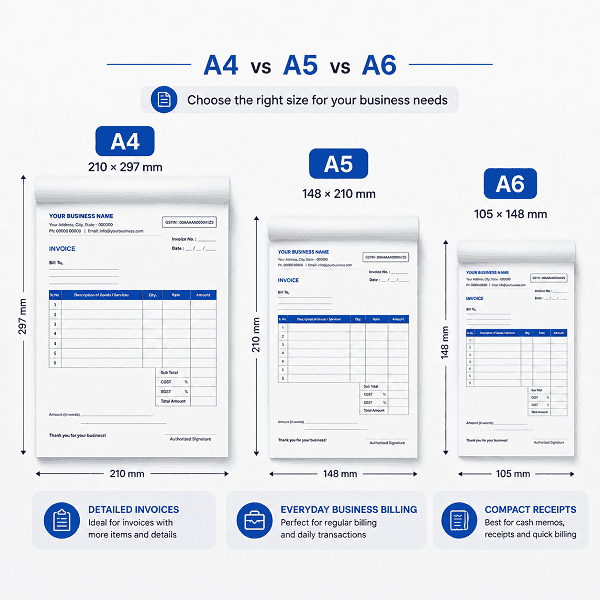
Common bill-book formats include A4, A5 and A6. Tagsen currently offers its custom bill books in all three sizes. Its product page also lists 50 pages or invoice sets per book and 80 GSM writing paper, depending on the selected format.
- A4 — detailed and itemised invoices
- A5 — everyday business billing
- A6 — compact receipts and cash memos
Which bill book size is best for small businesses?
A5 is often a practical option for businesses that need moderate writing space without using a full A4 sheet.
A4 may work better when invoices contain many products, detailed descriptions or multiple billing fields. A6 is more compact and can be useful for short receipts, cash memos or quick counter transactions.
The right bill book size should be based on how much information employees need to write on every bill rather than size alone.
Single vs Duplicate vs Triplicate Bill Books
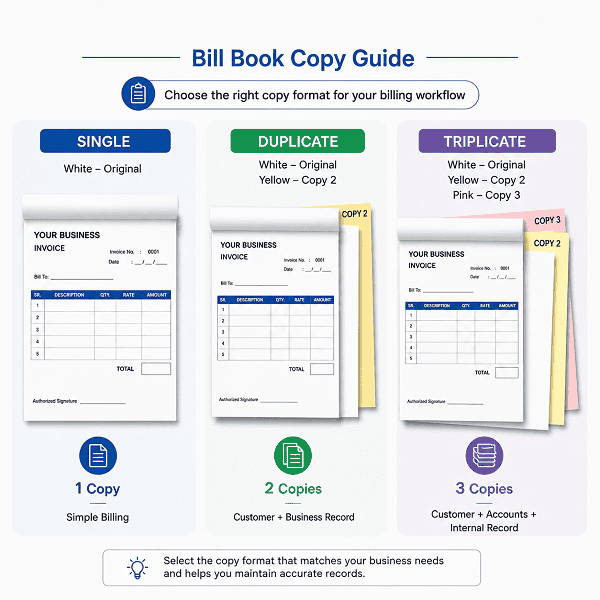
The main difference between single, duplicate and triplicate bill books is the number of copies created for each transaction.
| Feature | Single | Duplicate | Triplicate |
|---|---|---|---|
| Number of copies | 1 | 2 | 3 |
| Customer copy | Yes | Yes | Yes |
| Business or internal copy | — | Yes | Yes |
| Additional record | — | — | Yes |
| NCR commonly required | Not usually | Common | Common |
| Typical use | Simple billing | Two-record workflow | Multi-record workflow |
Tagsen's current bill book specification lists single-copy, duplicate and triplicate carbonless formats among the available structures.
When should a business use duplicate bill books?
A duplicate bill book is useful when the same transaction needs two records — for example, one copy for the customer and another for the business.
This can reduce the need to manually rewrite the same invoice information for internal records.
When is a triplicate bill book useful?
A triplicate format can be useful when three copies of the same transaction are required for a business workflow.
For example, separate copies may be retained by the customer and different internal departments. The exact purpose of each copy should be defined according to the company's own record-keeping process.
What Is NCR Paper in Bill Book Printing?
NCR commonly refers to carbonless paper used to create multiple corresponding copies without inserting a separate loose carbon sheet between every page.
Carbonless paper technology was developed specifically to reproduce written information across multiple sheets, making it useful for forms and multi-copy business documents.
How does NCR paper work?
In a multi-part form, pressure from handwriting or a writing instrument allows information entered on the top sheet to appear on the corresponding sheet or sheets underneath.
This means staff can complete multiple records during the same writing action.
Why is NCR paper used for duplicate bill books?
NCR bill book printing is useful for duplicate or triplicate formats because the business does not have to manually prepare each copy separately.
It can make physical billing more convenient when customers and businesses both need corresponding records.
How many copies can an NCR bill book have?
Carbonless forms can be produced in different multi-part configurations. For bill books, duplicate and triplicate structures are common examples.
The exact number of available copies should be confirmed with the printer before placing an order.
How Should a Professional Bill Book Be Designed?
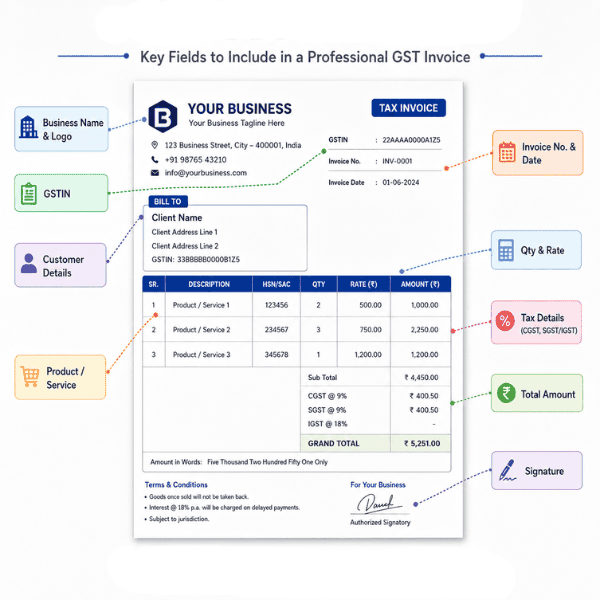
Good bill book design should make billing quick and easy to understand. Branding matters, but readability and writing space should come first.
What information should appear at the top?
The header can include the business logo, company name, address, contact information, GSTIN where applicable, invoice title, serial-number field and date field.
Avoid making the branding area so large that it reduces the space available for actual transaction details.
What should be included in the billing table?
A simple billing table may contain fields such as description, quantity, rate, tax and amount.
Businesses can add or remove fields based on their actual billing requirements.
What makes a bill book easy to use?
A practical layout generally uses:
- Readable fonts
- Clear spacing
- Logical field placement
- Adequate handwriting area
- Clear rows and columns
- Consistent business branding
The goal is not to fit the maximum amount of information onto the page. It is to make frequently used information easy to enter and read.
7 Bill Book Design Ideas for Different Businesses
Here are seven layout approaches used across retail, wholesale, food service and service-based businesses.
1. Retail Shop Bill Book Design
A retail bill book can use a simple itemised layout with customer details, product description, quantity, rate, tax fields where applicable and total amount.
Best for: General retailers, clothing stores and local shops.
2. Jewellery Shop Bill Book Design
A jewellery shop may benefit from additional writing space for detailed item descriptions, quantity, pricing and applicable billing information.
Best for: Jewellery stores issuing detailed physical invoices.
3. Hardware Store Bill Book Design
Hardware businesses often need multiple rows and sufficient space for product names, units, quantities and rates.
Best for: Hardware shops, building-material suppliers and distributors.
4. Medical Store Bill Book Design
A structured item table can make entries easier to organise. Any sector-specific or regulatory invoice requirements should be independently verified before finalising the format.
Best for: Businesses that need clear,
itemised transaction records.
5. Restaurant Bill Book Design
A compact design can work for shorter orders, while a larger format may be useful where more detailed billing fields are required.
Best for: Restaurants, cafés and food-service businesses using manual billing.
6. Wholesaler Bill Book Design
A wholesaler may benefit from a larger layout with more rows for descriptions, quantities, rates, taxable values and relevant tax fields.
Best for: Wholesalers and distributors handling multi-item orders.
7. Service Business Bill Book Design
Service businesses can emphasise customer information, service descriptions, charges, applicable tax details and the total rather than using unnecessary product-specific columns.
Best for: Repair services, consultants
and local service providers.
For businesses that issue quotations before billing, Tagsen also offers estimate pad printing in a similar customised format.
How Much Does Bill Book Printing Cost?
There is no single bill book price suitable for every order. Printing cost depends on the selected specifications.
Typical factors include:
- Quantity
- Size
- Single, duplicate or triplicate format
- Paper and copy structure
- Number of pages or invoice sets
- Black-and-white or colour printing
- Artwork or design requirements
- Finishing
- Delivery
Tagsen's current product configuration allows customers to select factors such as size, quantity, copy format and printing type, which affect the final price.
Why does bill book printing price change with quantity?
Commercial printing includes production and setup costs. When order volume changes, the effective cost per book can also change.
This is why businesses should compare the total order price as well as the cost per book before making a decision.
Is bulk bill book printing more cost-effective?
A larger print quantity may provide a lower effective unit cost, but businesses should still order according to realistic usage.
Ordering excessive stock can create another problem if business details, pricing fields or invoice requirements later need to change.
Want an exact price for your requirement? Check Tagsen's current custom bill book printing options and configure the size, quantity and copy format you need.
How to Choose the Right Bill Book for Your Business
Start with your actual billing workflow:
- Simple receipt or cash memo — compact single-copy format
- Customer copy plus office record — duplicate
- Three separate records — triplicate
- Detailed invoices — larger format
- Counter or mobile use — compact format
- Frequent billing — quantity based on realistic usage
The biggest or most expensive option is not automatically the best one. Choose a format that gives employees enough writing space and creates the number of records your business actually needs.
Online Bill Book Printing vs Local Printer
Both online and local printing can be suitable. The better option depends on how the business prefers to submit artwork, compare specifications, review designs and receive finished books.
| Factor | Online Printing | Local Printer |
|---|---|---|
| Ordering convenience | Can be completed remotely | May involve a visit or direct enquiry |
| Comparing listed options | Often straightforward | May require separate quotations |
| Customisation | Commonly available | Commonly available |
| Proofing | Usually digital | Digital or physical |
| Delivery | Shipped | Pickup or local delivery |
| Repeat ordering | Convenient when details are retained | Depends on printer workflow |
For businesses ordering remotely or repeatedly, bill book printing online can make it convenient to choose specifications and submit artwork without visiting a print shop.
Tagsen currently provides three artwork routes for bill books: customers can choose a ready-made template, upload print-ready artwork or use its custom-design option.
How Do You Prepare a Bill Book Design for Printing?
Which file format should you use?
PDF is widely used for commercial print handoff because it can preserve page dimensions and layout. However, the printer's own artwork specifications should always take priority.
Tagsen currently allows customers to upload print-ready artwork through its bill book ordering workflow.
What resolution should logos have?
Vector artwork is preferable for logos because it can be scaled without the same loss of sharpness associated with low-resolution raster images.
For raster artwork, around 300 PPI at final print size is a commonly used target for many commercial print applications, although the correct requirement depends on the printing process. Adobe's print guidance describes 300 PPI as a common general target rather than a universal requirement.
How much bleed is required?
Do not assume that every bill book needs the same bleed measurement.
If artwork reaches the trimmed edge, bleed extends the design beyond the final page boundary so minor trimming variation does not create unwanted white edges. Adobe recommends setting bleed according to the print job and including it when handing off the PDF.
Always follow the bill-book template or specification supplied by your printer.
What should be checked before printing?
Before approving your custom invoice book printing artwork, review the business name, address and contact details, GSTIN where applicable, invoice-number field, billing columns, copy format, bill-book size, logo quality, writing space, alignment, spelling, quantity and the final artwork version.
What Mistakes Should You Avoid When Ordering Bill Books?
1. Printing incorrect business or GST information
Check important information carefully before approving the design. A small error can be repeated throughout the entire print run.
2. Forgetting invoice-numbering requirements
Plan how invoice numbers will be entered or printed before production.
3. Leaving too little writing space
A visually attractive layout can still be frustrating if employees cannot comfortably write customer names, descriptions or amounts.
4. Using a low-quality logo
Low-resolution artwork may not reproduce clearly in print. Use suitable print-quality or vector artwork whenever possible.
5. Choosing the wrong quantity
Estimate how frequently the books will be used and whether business information is likely to change.
6. Choosing the wrong number of copies
Decide whether you need one, two or three corresponding records before ordering.
7. Skipping the final artwork review
Check names, numbers, fields, layout and spelling before approving production.
8. Selecting a format without considering daily use
Choose the size, paper and copy structure based on the way employees actually prepare bills.
What We Check Before a Custom Bill Book Goes to Print
A strong pre-print review should focus first on accuracy and usability.
For a custom bill-book order, important review points include logo clarity, business information, invoice fields, numbering requirements, copy format, writing space, page alignment and print-ready artwork.
Tagsen's current bill book service supports custom logo and business information, GSTIN fields, A4, A5 and A6 sizes, single through triplicate structures, black-and-white or colour printing, and multiple design-submission options.
How Can You Order Custom Bill Books Online?
Tagsen's current product page allows customers to choose bill-book specifications and either personalise a template, upload existing print-ready artwork or use its custom-design option.
A typical ordering process is:
- Step 1: Choose the required bill-book size.
- Step 2: Select quantity and copy format.
- Step 3: Choose the available printing specifications.
- Step 4: Select a template, upload artwork or create a custom design.
- Step 5: Review the business details and artwork carefully.
- Step 6: Confirm the order using the available checkout options.
Create custom bill books with your logo, business information and required billing layout. Order custom bill books online after comparing the available sizes, copy formats and printing options.
Frequently Asked Questions About Bill Book Printing
What is bill book printing?
Bill book printing is the process of producing customised books for invoices, receipts, cash memos or other transaction records. Businesses can add their logo, company information, invoice fields, numbering and other relevant details to create a structured physical billing format.
Can I print my GST number on a bill book?
Yes. A custom bill book can include a GSTIN and relevant GST fields. Tagsen currently supports GSTIN and related business-detail customisation. However, businesses should verify the particulars required for their own invoices under applicable GST rules rather than assuming a standard template is suitable for every transaction.
What size is best for a bill book?
A5 can be suitable for everyday billing where moderate writing space is needed. A4 offers more room for detailed invoices, while A6 is more compact for shorter receipts or cash memos. Tagsen currently offers A4, A5 and A6 bill-book sizes.
What is a duplicate bill book?
A duplicate bill book creates two corresponding records of the same transaction. One can be provided to the customer while the second is retained according to the business's record-keeping process.
What is a triplicate bill book?
A triplicate bill book creates three corresponding copies of a transaction. It can be useful when several parties or departments require their own physical record.
What is NCR paper?
NCR generally refers to carbonless copy paper used to reproduce written information across multiple sheets without inserting a separate loose carbon sheet. Carbonless technology is commonly used for multi-part forms and business records.
Can a bill book include my logo?
Yes. Custom bill book printing can include a logo, business name, address, GSTIN and other relevant details. Tagsen currently lists these customisation options for its bill books.
Can I order custom bill books online?
Yes. Tagsen currently allows customers to configure and order bill books online, choose from A4, A5 and A6 sizes, and either use a template, upload print-ready artwork or choose its design option.
Final Thoughts
The best printed bill book is one that makes everyday billing clear and practical.
Start by deciding how much information each invoice needs, how many copies must be retained and how much writing space is required. Then choose the size, layout and copy format that best fits that workflow.
Accurate business information, readable fields, appropriate spacing and clear branding are more valuable than adding unnecessary design elements.
Whether you need a compact receipt book, a duplicate carbonless format or a detailed custom invoice book, choosing the right structure before printing can make physical billing easier to manage. Explore Tagsen's bill book printing options to compare available sizes, formats and customisation choices for your business.