
How Custom Packaging Design and Printing Can Help Boost Sales
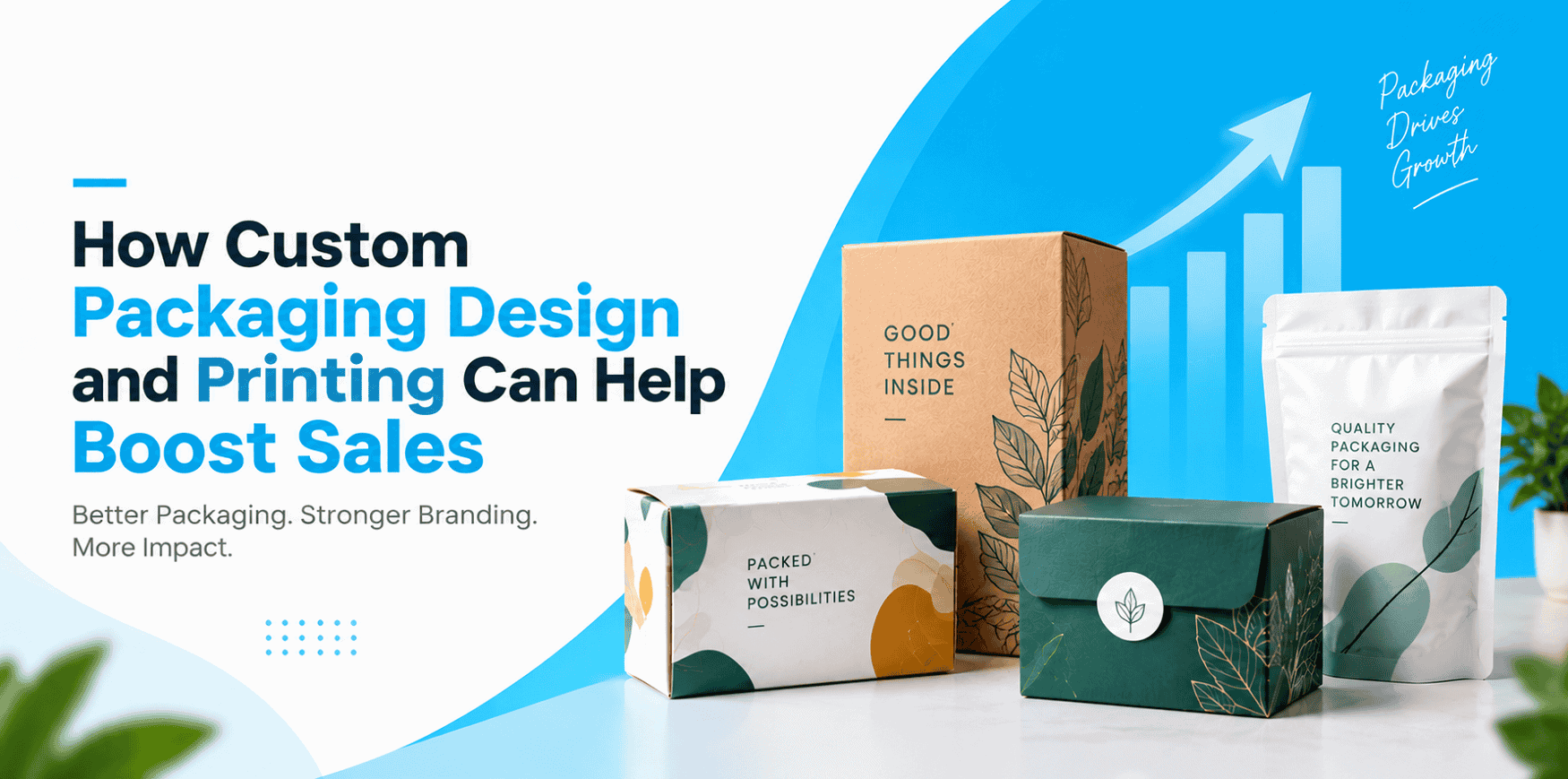
Packaging is often one of the first things a customer notices about a physical product. Before opening a box, tasting a food item, wearing jewellery or using a product, buyers may already have formed an impression based on its colours, logo, label, material and overall presentation.
Custom packaging design combines branding, product information, visual presentation and functional structure for a specific product. Custom packaging printing adds elements such as logos, colours, graphics, product details and promotional messages to boxes, labels, stickers, sleeves, bags and other packaging materials.
When these elements work together, packaging can help customers notice a product, understand what it offers and recognise the brand behind it.
Key Takeaway
Good product packaging should do four things well:
- Protect the product
- Explain the product clearly
- Present the brand consistently
- Make important information easy to notice
Attractive packaging can support product presentation, but it cannot replace product quality, appropriate pricing or good customer service. The strongest packaging accurately represents the product inside.
How Does Packaging Design Influence Buying Decisions?
Packaging can influence buying decisions by helping customers quickly understand what a product is, who it is for and how it differs from nearby alternatives.
Imagine two similar products placed next to each other.
One has crowded graphics, several fonts and important information that is difficult to find. The other clearly shows the brand name, product type, variant and essential details.
The second package does not automatically make the product better, but it makes it easier for customers to identify, understand and compare.
Several packaging elements can contribute to that experience:
- Logo and brand colours
- Typography
- Product imagery
- Packaging shape
- Material and finish
- Product labels
- Printed information
- Visual hierarchy
The objective is not simply to make packaging decorative. It should help communicate genuine product value clearly.
What Makes Product Packaging Effective?
Effective packaging balances design, information, branding and functionality.
| Packaging Element | Why It Matters |
|---|---|
| Product name | Helps customers identify the product quickly |
| Brand logo | Supports brand recognition |
| Clear typography | Makes information easier to read |
| Brand colours | Creates visual consistency |
| Product information | Helps customers evaluate the product |
| Suitable material | Supports protection and handling |
| Quality printing | Keeps text and graphics clear |
| Functional structure | Supports opening, storage and transportation |
A package does not need every available finish or visual effect. It needs the elements that are suitable for the product, customer and selling environment.
Keep Packaging Design Simple and Clear
Packaging provides limited space, which makes visual hierarchy important.
Customers should be able to understand the product without searching through unnecessary text or graphics.
A simple front-panel hierarchy might be:
Brand → Product Name → Variant or Main Benefit → Supporting Information
Additional information can appear on the back, side panels or product label where appropriate.
This approach is especially useful in retail environments where customers may compare several products within a short period.
Use Honest and Accurate Product Information
Packaging should accurately represent the product inside.
Avoid misleading quantities, exaggerated visuals or claims that cannot be supported. Instead, clearly communicate information customers genuinely need.
Depending on the product category, this may include:
- Product name
- Size or quantity
- Variant
- Ingredients or materials
- Usage instructions
- Care information
- Manufacturer information
- Contact details
- Required regulatory information
Clear product information makes comparison easier and supports customer trust.
When product information needs to be added to bottles, jars, boxes or pouches, professionally printed packaging labels can combine branding with important product details in a compact format.
Maintain Consistent Branding Across Packaging
Customers are more likely to recognise a brand when its visual identity remains consistent.
Your logo, colours, typography and overall design language should feel connected across different touchpoints.
For example, the same identity may appear on:
- Product packaging
- Labels
- Stickers
- Paper bags
- Inserts
- Thank-you cards
- Promotional print material
The format can change without making the brand look completely different.
For businesses using standard boxes or containers, custom stickers can be a flexible way to add logos, brand messages, QR codes or seals without developing fully custom structural packaging.
Design Packaging for Both Shelf and Screen
Product packaging may now be seen in a physical shop, on an e-commerce website, on a marketplace or through social media.
A design that looks attractive on a large monitor may not work equally well when displayed as a small mobile thumbnail.
For retail packaging, consider:
- Shelf visibility
- Colour contrast
- Product-name readability
- Brand recognition
- Distance from the customer
For online sales, also consider:
- Mobile-screen readability
- Product photography
- Thumbnail visibility
- Front-facing information
Before approving artwork, view the design both at its actual printed size and as a small digital image.
This simple check can reveal typography or important details that may otherwise be overlooked.
Why Is Packaging Functionality Important?
Packaging must protect the product as well as present it.
The right packaging format depends on factors such as:
- Product dimensions
- Product weight
- Fragility
- Storage conditions
- Moisture exposure
- Transportation
- Opening and closing requirements
- Customer handling
A jewellery box, food pouch, cosmetic container and shipping box each have different requirements.
Choosing packaging only because it looks premium can cause problems if the structure or material does not suit the product.
The material, printing method and structure should therefore be considered together.
How Does Custom Packaging Printing Strengthen Branding?
Custom packaging printing places a brand's visual identity directly on the materials customers receive.
Depending on the product and budget, businesses may customise:
- Boxes
- Labels
- Stickers
- Sleeves
- Bags
- Inserts
- Cards
Printed elements can include:
- Logo
- Product name
- Brand colours
- Instructions
- QR codes
- Website information
- Social media details
- Promotional messages
For premium gifting, jewellery, cosmetics, festive hampers or retail presentation, custom gift packing boxes can combine product protection with branded presentation.
The best option depends on the product, quantity, budget and customer experience a business wants to create.
Do Small Businesses Need Fully Custom Packaging?
Not always.
Small businesses can build a professional packaging system gradually rather than investing in completely customised packaging from the beginning.
A practical starting combination might include:
- A suitable standard box, bottle, jar or pouch
- A professionally printed label
- A logo sticker
- A branded insert
- Consistent colours and typography
For example, a small food, cosmetic or handmade-product business may start with standard containers and branded labels before moving to fully customised boxes.
This approach allows packaging investment to increase alongside order volume.
Retail Packaging vs E-commerce Packaging
Retail and e-commerce packaging share branding goals but often have different priorities.
| Retail Packaging | E-commerce Packaging |
|---|---|
| Competes visually with nearby products | Needs to withstand transportation |
| Shelf visibility matters | Product protection is especially important |
| Front design needs quick impact | Unboxing experience has greater importance |
| Customers can inspect packaging directly | Customers often see product photographs first |
| Comparison happens on the shelf | Branding continues after delivery |
Brands selling through both channels should consider both environments before approving a large packaging print run.
How Can Printed Inserts Improve the Unboxing Experience?
Packaging does not need to carry every message itself.
Printed inserts can provide additional information without making the main package crowded.
Businesses might include:
- Product instructions
- Care information
- QR codes
- Review requests
- Social media details
- Discount codes
- Thank-you messages
For e-commerce, D2C brands, gifts and customer orders, custom thank-you cards can be used as branded packaging inserts to add a message, QR code or customer note.
Keeping these materials visually consistent with the main packaging helps create a more unified experience.
How Can Print Marketing Support Product Packaging?
Packaging can introduce the product and brand, while other printed materials can support launches, promotions and repeat purchases.
For example, businesses may use:
- Promotional inserts
- Product information cards
- Discount vouchers
- QR code cards
- Flyers
- Brochures
A new product launch might combine branded packaging with promotional flyers containing an introductory offer, QR code or information about related products.
The important principle is consistency. Printed marketing materials should look like an extension of the packaging rather than a completely unrelated design.
What Should You Check Before Printing Packaging?
A proper pre-print review can prevent many avoidable mistakes.
Check the Packaging Dimensions
Confirm:
- Width
- Height
- Depth
- Label dimensions
- Product fit
- Cutting positions
- Folding positions
Incorrect measurements can affect both appearance and functionality.
Check Artwork Quality
Review:
- Logo resolution
- Image quality
- Text readability
- Colour setup
- Correct artwork version
Images and logos that appear acceptable when enlarged on a computer may look poor at actual print size.
Check the Print Layout
Verify:
- Bleed
- Safe area
- Cutting line
- Folding line
- Dieline placement
Important logos or text should not be placed too close to trimming or folding areas.
Check Product Information
Confirm:
- Product name
- Quantity
- Variant
- Contact details
- Instructions
- Required information
- Spelling and grammar
Review the Final Proof
Where practical, check the final digital proof or physical sample before approving a large production quantity.
A small artwork error can become much more expensive once hundreds or thousands of pieces are printed.
Practical Packaging Tip
Always review packaging artwork at actual print size before approval.
Design software makes it easy to zoom in and view small text at 200% or 300%. That can make typography look perfectly readable even when it will be difficult to see on the final product.
Viewing artwork at its intended size gives a much more realistic idea of:
- Text readability
- Logo visibility
- Spacing
- Visual hierarchy
- QR code placement
Also check whether important elements stay comfortably inside the safe area and away from cuts or folds.
Common Packaging Design Mistakes to Avoid
Some common packaging mistakes include:
- Using too many fonts
- Adding excessive information to the front panel
- Choosing colours with poor contrast
- Making important text too small
- Using low-resolution images
- Using an incorrect dieline
- Ignoring actual product dimensions
- Selecting materials only for appearance
- Copying a competitor's visual identity too closely
- Using inconsistent branding
- Printing large quantities without checking the final proof
The goal should not be to make packaging visually busy.
The goal is to make the product clear, recognisable, practical and suitable for its intended use.
Can Packaging Improve Brand Recall?
Packaging can support brand recall when customers repeatedly see the same visual cues.
These may include:
- Logo
- Colour palette
- Typography
- Product naming
- Label style
- Packaging structure
When these elements remain consistent across products, packaging, marketing material and online channels, customers have more opportunities to associate them with the brand.
Brand recognition therefore comes from consistency rather than simply making the logo larger.
What Packaging Cannot Do
Packaging plays an important role in presentation, but it should not be treated as a solution to every sales problem.
Attractive packaging cannot reliably compensate for:
- Poor product quality
- Incorrect pricing
- Misleading claims
- Weak customer service
- Poor product-market fit
- Inconsistent delivery
Packaging works best when it communicates the genuine value of a good product.
How Tagsen Supports Custom Packaging and Printing
Tagsen India provides custom printing and packaging solutions for businesses across India.
Depending on the product and branding requirements, businesses can explore labels, stickers, gift boxes, thank-you cards and supporting promotional print materials.
Businesses looking for broader guidance on coordinating packaging and print branding can also explore Tagsen's guide to printing and packaging design services.
Before selecting a packaging solution, consider:
- Product type
- Dimensions
- Order quantity
- Material requirements
- Target customer
- Selling environment
- Branding requirements
- Transportation needs
- Available artwork
These details make it easier to choose an appropriate packaging and printing approach rather than selecting options based on appearance alone.
Final Thoughts
Effective packaging is about more than making a product look attractive.
Strong custom packaging design and printing combines clear branding, accurate product information, suitable materials, functional structure and professional presentation.
The objective is simple: create packaging that protects the product, helps customers understand what they are buying and makes the brand easier to recognise.
When packaging, labels, stickers, inserts and promotional materials follow a consistent visual identity, they can create a stronger customer experience across retail, e-commerce, gifting and direct orders.
Planning Custom Packaging for Your Product?
Before discussing a packaging requirement, prepare:
- Product type
- Product dimensions
- Required quantity
- Preferred packaging format
- Material preference
- Branding requirements
- Artwork availability
Sharing these details with Tagsen can make it easier to evaluate a suitable custom printing and packaging option for your product.
Frequently Asked Questions
What is custom packaging printing?
Custom packaging printing is the process of adding logos, colours, graphics, product information or promotional elements to packaging materials such as boxes, labels, stickers, sleeves and bags.
How can packaging design influence sales?
Packaging can help customers notice, identify and evaluate a product. Clear branding and useful information can support purchase decisions, although product quality, price, reputation and customer needs remain important.
Does custom packaging help brand recognition?
Yes. Consistent use of logos, colours, typography and other visual elements across packaging can make a brand easier to recognise across different products and sales channels.
Can small businesses use custom packaging?
Yes. Small businesses can start with standard boxes, bottles, jars or pouches and add custom labels, stickers or printed inserts before investing in fully customised packaging.
What information should product packaging include?
This depends on the product category. Common information includes the product name, brand, quantity, variant, usage instructions, contact details and any product-specific information required for the category.
Are labels and stickers useful for packaging?
Yes. Labels and stickers can add branding, product information, instructions, barcodes, QR codes and variant details without requiring all information to be printed directly on the main package.
What should I check before bulk packaging printing?
Check dimensions, product fit, artwork resolution, spelling, logo placement, colours, bleed, safe area, dieline, material and product information. Review the final proof before production whenever possible.
Is attractive packaging more important than product quality?
No. Attractive packaging can improve presentation and make product information easier to communicate, but it cannot replace product quality. Packaging works best when it accurately represents a good product.