
Packaging Materials Guide: How to Choose the Right Material for Your Product
How to Choose the Right Packaging Materials for Your Product
Last Updated: October 2026
Choosing the right packaging materials depends on your product’s size, weight, fragility, shipping method, presentation needs and budget. Paper, paperboard, corrugated board, rigid boxes and inner wrapping materials all serve different purposes.
For businesses, the best packaging is not simply the strongest or most expensive option. It is the material and structure that protects the product, supports your brand presentation and works within your required quantity and budget.
What Are Packaging Materials?
Packaging materials are used to contain, protect, present, store and transport products. They can form the outer package, such as a box or bag, or act as an inner layer, such as wrapping paper, tissue paper or an insert.
The right packaging material can help:
- Protect products during storage and delivery
- Improve shelf and unboxing presentation
- Keep products organised inside the pack
- Display branding and product information
- Make handling, gifting or shipping easier
A product sold at a retail counter may need very different packaging from the same product being shipped by courier.
Which Packaging Material Is Best for Your Product?
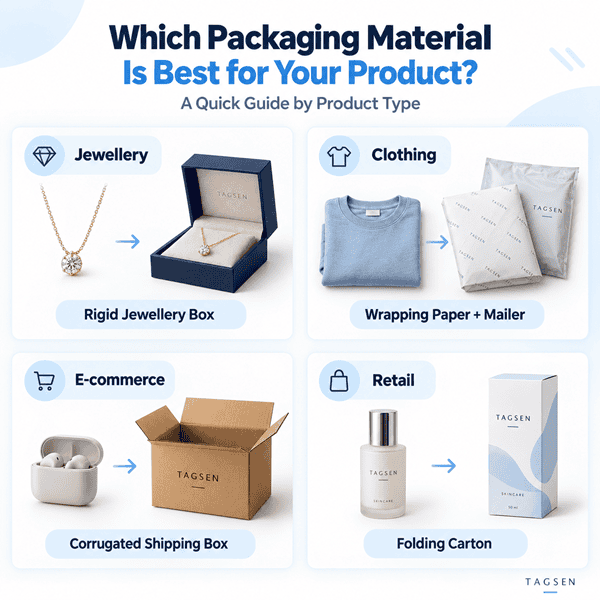
There is no single packaging material that works best for every product. A useful starting point is to match the product with the level of protection and presentation it needs.
| Product Type | Common Packaging Option | Main Benefit |
|---|---|---|
| Jewellery | Rigid jewellery box with insert | Protection + premium presentation |
| Clothing & garments | Branded wrapping + outer box or mailer | Presentation + shipping |
| Ecommerce products | Corrugated or mailer-style box | Transit protection |
| Gifts | Rigid or folding gift box | Better gifting presentation |
| Retail products | Folding carton or mono carton | Branding + shelf display |
| Lightweight products | Paper bag or folding carton | Convenient handling |
| Premium products | Rigid box + tissue or insert | High-end presentation |
This product-first approach is more useful than choosing packaging based only on appearance.
Types of Packaging Materials
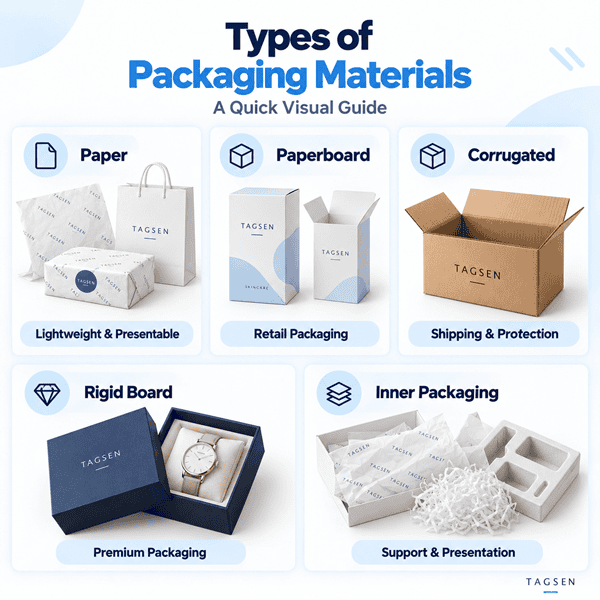
1. Paper Packaging Materials
Paper packaging is commonly used for lightweight products, wrapping, retail bags and presentation layers. It can be suitable for:
- Paper bags
- Garment wrapping
- Tissue paper
- Packaging sleeves
- Gift wrapping
- Lightweight retail packaging
For clothing and fashion products, Custom Garment Wrapping Paper can be used as a branded inner layer before the product is placed inside its final box, bag or mailer.
Paper packaging is especially useful when branding and presentation matter but a heavy rigid structure is not required.
2. Paperboard and Folding Cartons
Paperboard is commonly used for folding cartons, mono cartons and other structured retail packaging. Typical applications include:
- Cosmetics
- Personal care products
- Small retail items
- Accessories
- Promotional products
Paperboard provides useful printable space for logos, instructions, product information and brand graphics while remaining more compact than rigid packaging.
3. Corrugated Packaging
Corrugated packaging is generally chosen when shipping protection is a major requirement. It is commonly used for:
- Ecommerce orders
- Courier shipments
- Subscription products
- Multi-item packs
- Products that need more transit protection
When choosing corrugated or mailer-style packaging, consider the product’s weight, dimensions, empty space and how the parcel will be handled during delivery.
For ecommerce brands, the shipping box can also form part of the unboxing experience when branding is added appropriately.
4. Rigid Packaging Materials
Rigid packaging is useful when both protection and presentation are important. Tagsen’s Custom Gift Packing Boxes are suitable for gifting, jewellery, premium retail and other presentation-focused applications.
Rigid boxes are commonly used for:
- Jewellery
- Corporate gifting
- Wedding gifts
- Premium accessories
- Festive products
- Luxury retail items
For jewellery businesses, Tagsen also offers Custom Jewellery Boxes designed for different jewellery categories and presentation needs.
5. Inner and Protective Packaging
The outer box is only one part of a complete packaging system. Inner packaging can help:
- Hold products in position
- Reduce movement
- Separate multiple items
- Improve presentation
- Create a cleaner unboxing experience
This may include wrapping paper, tissue paper or inserts.
For jewellery, an insert can help keep the item in position. For apparel, wrapping paper can create a branded presentation layer before the customer reaches the product.
How to Choose the Right Packaging Material in 6 Steps
1. Consider the Product Weight
Start with the product’s weight and dimensions. Lightweight products may work well with paper bags, paperboard cartons or wrapping, while heavier products generally require a stronger structure.
Avoid using an oversized box only for appearance. Extra empty space can increase material use and may allow the product to move inside the pack.
2. Check Product Fragility
Ask what could happen to the product during handling, display or transit. Fragile and delicate products may need:
- A structured outer box
- Correctly sized inserts
- Inner wrapping
- Reduced empty space
For example, jewellery often benefits from product-specific packaging rather than a generic box.
Tagsen’s Custom Chain Boxes are designed for chain and pendant presentation, while other jewellery formats can be matched to earrings, necklaces and bangles.
3. Decide Between Retail and Shipping Packaging
Retail packaging and shipping packaging solve different problems.
Retail packaging focuses more on:
- Shelf presentation
- Branding
- Product information
- Customer experience
Shipping packaging focuses more on:
- Transit protection
- Closure
- Strength
- Efficient dimensions
Some ecommerce brands may need both: branded product packaging inside a stronger outer shipping package.
4. Consider Moisture and Handling Conditions
Think about where the package will be stored and how it will be handled. Ask:
- Will it remain indoors?
- Could it be exposed to moisture?
- Will customers carry it outdoors?
- Will it be delivered by courier?
- Does the product need extra surface protection?
The material should match these practical conditions rather than being selected only for appearance.
5. Think About Branding and Printing
Packaging is also a branding surface. Depending on the product, you may want to include:
- Logo
- Brand colours
- Product name
- Instructions
- QR code
- Social media details
- Care information
- Thank-you message
The packaging structure should therefore be selected together with the printing requirement.
For premium gift and jewellery packaging, branding can be kept minimal while still creating a strong presentation through colour, logo placement and box structure.
6. Compare Quantity and Budget
The right packaging must also make commercial sense. Before finalising your packaging, compare:
- Required quantity
- Product dimensions
- Printing requirements
- Material or box type
- Finishing
- Inserts
- Storage requirements
- Per-unit budget
For smaller businesses, a standard-size format with simpler branding may be more practical than a highly customised structure. Larger orders may justify more specific dimensions, finishes or inserts.
Not sure which structure is suitable for your product? Share your product type, dimensions, required quantity and whether it is for retail, gifting or shipping. Tagsen can help narrow down suitable packaging options.
Packaging Material Comparison by Product Type
Jewellery Packaging
Jewellery packaging should balance fit, protection and presentation. A rigid jewellery box with the right insert can help keep the product positioned correctly while creating a premium presentation.
Tagsen offers several jewellery packaging formats, including:
- Custom Jewellery Boxes
- Custom Earring Boxes
- Custom Necklace Boxes
- Custom Chain Boxes
- Custom Bangle Boxes
Common direction: rigid box + suitable insert.
Apparel and Garments
For apparel, packaging should protect the garment while maintaining a clean presentation. A useful setup can be: branded wrapping paper → outer bag, mailer or box.
Custom Garment Wrapping Paper can be used to add a branded inner layer before the garment is packed for retail or delivery.
Common direction: branded inner wrapping + suitable outer packaging.
Ecommerce Products
Ecommerce packaging should be selected with transit conditions in mind. Consider:
- Product dimensions
- Product weight
- Fragility
- Empty space
- Closure
- Courier handling
A decorative product box may still need an outer shipping package depending on the product and delivery conditions.
Common direction: protective outer structure + branded inner presentation where needed.
Gifts and Premium Products
Premium products usually benefit from packaging that feels intentional rather than generic. Tagsen’s Custom Gift Packing Boxes can be used for jewellery, corporate gifts, wedding gifting and other premium applications.
Common direction: rigid or structured gift box + branding + optional insert.
Retail Products
Retail products often need packaging that is compact, printable and easy to display. Depending on the product, common formats can include:
- Folding cartons
- Mono cartons
- Sleeves
- Paper bags
Common direction: select the structure according to product size, shelf requirement and available branding area.
Packaging Material vs Packaging Design: What Is the Difference?
Packaging material and packaging design are related, but they are not the same thing.
Packaging material refers to what the package is made from, such as paper, paperboard, corrugated board or rigid board. Packaging design refers to how that material is converted into the final package.
Design can include:
- Size
- Shape
- Opening style
- Inserts
- Printing
- Colour
- Logo placement
- Finish
For example, two businesses may use the same rigid-board material but choose completely different dimensions, colours, opening styles and finishes. Choosing the material is therefore only the first step.
How Can Custom Packaging Improve Product Presentation?
Custom packaging allows the package to be designed around the product and brand rather than forcing the product into a generic format.
Depending on the packaging type, customization can include:
- Product-specific dimensions
- Logo printing
- Brand colours
- Inner printing
- Paper finishes
- Inserts
- Different opening styles
Good packaging does not need to be complicated. A correctly sized package with clear branding and suitable internal support can often create a stronger result than an oversized package with unnecessary decoration.
For jewellery businesses, product-specific boxes also make it easier to use different formats for chains, earrings, necklaces and bangles while maintaining a consistent brand identity.
Are Paper Packaging Materials Always More Eco-Friendly?
Not necessarily. The environmental impact of packaging depends on several factors, including:
- Material source
- Amount of material used
- Coatings or laminations
- Recyclability
- Reusability
- Transportation
- Disposal
Businesses should avoid claims such as “100% eco-friendly” unless the specific material and supply chain genuinely support that statement.
A practical starting point is to use appropriately sized packaging and avoid material that does not add protection, usability or presentation value.
Need Help Choosing Packaging for Your Product?
If you are unsure which packaging format is suitable, start with these details: product type + dimensions + approximate weight + required quantity + intended use.
Also mention whether the packaging is for:
- Retail
- Ecommerce shipping
- Gifting
- Jewellery
- Apparel
- Premium presentation
This information helps narrow down the most suitable structure and material.
You can explore Tagsen’s Custom Gift Packing Boxes, Custom Jewellery Boxes and Custom Garment Wrapping Paper for different product requirements.
Need a packaging recommendation? Share your product details and quantity with Tagsen to discuss suitable custom packaging options.
Frequently Asked Questions About Packaging Materials
What are the most common packaging materials?
Common packaging materials include paper, paperboard, corrugated board, rigid board and inner wrapping materials. The right option depends on the product’s size, weight, fragility, shipping method and presentation requirements.
How do I choose the right packaging material for my product?
Start with the product’s dimensions, weight and fragility. Then consider whether it will be displayed in-store or shipped, how much branding is required, the expected quantity and your packaging budget.
Which packaging material is best for shipping?
Corrugated packaging is commonly used for shipping because its layered structure can provide additional strength and protection. The exact structure should still be selected according to product weight, dimensions and transit conditions.
Which packaging material is suitable for jewellery?
Rigid jewellery boxes with suitable inserts are commonly used because they provide structure, protection and premium presentation. Different formats can be selected for earrings, necklaces, chains and bangles.
What is the difference between cardboard and corrugated packaging?
Paperboard or cardboard is commonly used for lighter folding cartons and retail packaging. Corrugated packaging uses a layered structure that is generally more suitable for shipping and handling.
Which packaging materials can be customized with a logo?
Many paper, paperboard and rigid packaging formats can support logo printing. Available printing methods, finishes and minimum quantities depend on the specific packaging product.
What packaging material is suitable for a small business?
Small businesses should choose packaging based on product requirements rather than business size. Start with the necessary protection, then compare quantity, dimensions, branding options and per-unit budget.
Can packaging be customized by size and design?
Many custom packaging formats can be produced in different sizes, colours, structures and print designs. Availability depends on the specific packaging type and order requirement.
What details should I send to get a packaging recommendation?
Share your product type, dimensions, approximate weight, required quantity and whether the packaging is for retail, gifting or shipping. These details make it easier to recommend suitable materials and structures.
About Tagsen
Tagsen India Pvt. Ltd. provides custom printing and packaging solutions for businesses across India, including gift boxes, jewellery packaging, garment wrapping paper, stickers, labels and other branded print products.
Published by: Tagsen India Pvt. Ltd.