
Last updated : September | Author: Tagsen India
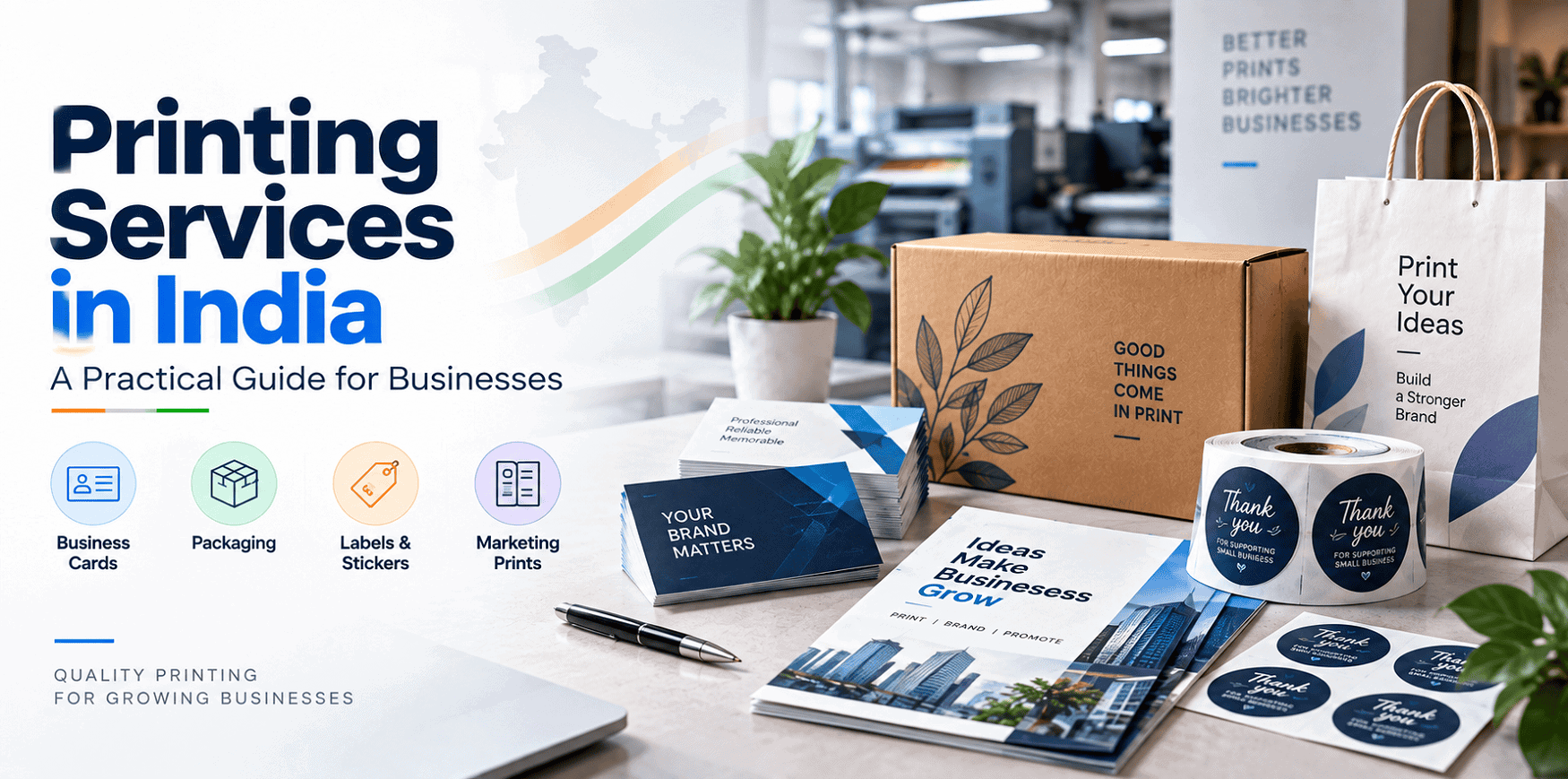
Printing services in India help startups, small businesses, retailers, e-commerce brands and corporate teams create customized business cards, packaging, stickers, labels, stationery and promotional materials.
With online printing, businesses can select a product, choose its size, material, quantity and finishing, upload artwork and place an order without repeatedly visiting a physical printing shop.
But choosing a printing service should not be based on price alone. Material quality, printing method, finishing, artwork preparation, minimum order quantity, proofing and delivery timeline can all affect the final result.
A good printing service should match the product, material, quantity, artwork and delivery requirement of your business. Digital printing is generally practical for smaller or personalized orders, while offset printing can be more economical for larger repeated runs. Before approving production, always confirm the size, material, print method, finish, proof and final artwork.
What Is an Online Printing Service?
An online printing service allows customers to order customized printed products through a website.
The process usually includes selecting a product, choosing the required specifications, uploading artwork, reviewing the order and approving it for production.
After approval, the printing provider handles production, finishing, packing and dispatch.
For businesses, online printing can simplify the process of maintaining consistent branding across business cards, packaging, labels, stationery and marketing materials.
Tagsen offers online printing options for customized business stationery, packaging, stickers, labels and selected promotional products.
Who Uses Printing Services in India?
Printing services are useful for businesses, professionals, institutions and individuals who need branded or customized print products.
Common users include:
- Startups and small businesses
- Retail shops
- E-commerce and D2C brands
- Corporate offices
- Jewellery businesses
- Fashion and clothing brands
- Restaurants and food businesses
- Schools and colleges
- Event organizers
- Marketing teams
- Independent professionals
A startup may initially need business cards, letterheads and flyers, while an e-commerce business may focus more on packaging, product labels, stickers and inserts.
The right product depends on its purpose, quantity, budget and how customers will interact with it.
What Can You Order from a Printing Company?
A business printing company may offer products for branding, packaging, promotion, retail use and everyday office requirements.
Business Cards and Office Stationery
Business stationery helps maintain a consistent and professional brand identity.
Common products include:
- Matte laminated business cards
- Letterheads
- Envelopes
- Bill books
- Notepads
- Diaries
- Certificates
- Calendars
- Presentation folders
Business cards may also use finishes such as matte lamination, gloss lamination, foil, embossing or Spot UV.
The finish should support the design rather than simply make the card look expensive. A clean corporate design may work well with matte lamination, while foil or Spot UV can help selected brand elements stand out.
Custom Packaging
Packaging protects a product while also influencing how customers see the brand.
Common packaging products include:
- Gift boxes
- Custom jewellery boxes
- Rigid boxes
- Folding cartons
- Paper bags
- Product sleeves
- Packaging inserts
- Shagun envelopes
Before ordering custom packaging, confirm the actual dimensions of the product.
Also consider:
- Product weight
- Product shape
- Fragility
- Storage requirements
- Shipping conditions
- Presentation requirements
- Required quantity
For large or highly customized packaging orders, checking a sample or prototype before bulk production can help reduce sizing and structural mistakes.
Stickers and Labels
Stickers and labels are commonly used for branding, product identification, instructions and promotions.
Businesses may use:
- Logo stickers
- Product labels
- Bottle labels
- Custom window stickers
- Transparent stickers
- White plastic stickers
- Packaging labels
- Push-pull stickers
- White-ink clear stickers
The right material depends on the surface and environment.
For example, a label used on a dry cardboard box may have different requirements from a label applied to a chilled bottle exposed to moisture.
Before ordering, consider:
- Application surface
- Indoor or outdoor use
- Exposure to water or moisture
- Required adhesive strength
- Expected handling conditions
Promotional Printing
Promotional printing can support local marketing campaigns, exhibitions, store openings, events and product launches.
Products may include:
- Flyers
- Brochures
- Posters
- Banners
- Door hangers
- Custom printed caps
- Event invitations
- Branded promotional materials
Promotional prints should be easy to scan.
The offer, brand name, contact information and call to action should remain clearly visible without overcrowding the design.
Digital Printing vs Offset Printing: Which Is Better?
Digital printing is generally suitable for smaller quantities, faster setup and personalized designs. Offset printing is often more practical for larger quantities where the same design will be repeated.
Neither method is automatically better for every project.
| Factor | Digital Printing | Offset Printing |
|---|---|---|
| Best suited for | Small to medium quantities | Medium to large quantities |
| Setup | Usually faster | Requires more initial setup |
| Personalization | Suitable for variable designs | Better for repeated artwork |
| Turnaround | Often faster for short runs | Setup can increase production time |
| Cost efficiency | Practical for smaller quantities | Often economical for bulk quantities |
| Typical uses | Cards, stickers, labels, samples | Packaging, brochures, bulk stationery |
When Should You Choose Digital Printing?
Digital printing can be a good option when:
- You need a smaller quantity
- You need faster setup
- Different names or designs are required
- You want personalized printing
- You want to test a small batch first
When Should You Choose Offset Printing?
Offset printing may be better when:
- You require a large quantity
- The same design will be repeated
- Consistent production across a large run is important
- You are printing bulk stationery or packaging
- Reducing the per-piece cost at scale is important
For commercial printing, the final method should ideally be selected after reviewing the product, material, artwork, quantity and finishing requirements.
What Affects Printing Cost in India?
Printing cost depends on the specifications of the order rather than one fixed rate.
Quantity
Larger quantities can reduce the cost per piece because setup costs are spread across more units.
Material
Standard paper, premium paper, board, synthetic material and specialty substrates can have different costs.
Size
A larger finished size may use more material and affect printing, cutting, packing and shipping costs.
Printing Method
Digital and offset printing use different production processes and cost structures.
Printing Sides
Single-sided and double-sided printing may have different pricing.
Finishing
Additional processes can increase both cost and production time.
These may include:
- Lamination
- Foil printing
- Spot UV
- Embossing
- Debossing
- Die cutting
For a more accurate quotation, provide the printer with:
- Finished size
- Quantity
- Material preference
- Printing sides
- Required finish
- Artwork status
- Delivery location
- Required date
A detailed print brief is more useful than simply asking for the lowest printing price.
What Printing Finishes Are Available?
Finishing affects the appearance, feel or durability of printed products.
Matte Lamination
Matte lamination creates a smooth, low-reflection surface. It is commonly used for business cards, packaging and premium printed materials.
Gloss Lamination
Gloss lamination creates a brighter, reflective surface and can make colours appear more vibrant.
Foil Printing
Foil printing adds a metallic effect to selected design elements.
It is commonly used for logos, names, borders and patterns on invitations, packaging, labels and premium business cards.
Embossing and Debossing
Embossing raises a selected element above the surface.
Debossing presses the element into the material.
Both techniques can add a tactile effect to logos and important design elements.
Spot UV
Spot UV creates a glossy coating on selected areas rather than coating the entire product.
It is especially noticeable when glossy details are combined with a matte surface.
Not every finish works equally well on every material, so compatibility should be confirmed before production.
How Does Online Printing Work?
The online printing process usually follows these steps:
1. Select the Product
Choose the required product such as a business card, sticker, label, box, flyer or banner.
2. Choose the Specifications
Select the size, material, quantity, printing sides and available finishing options.
3. Prepare and Upload the Artwork
Provide the artwork according to the required size and file specifications.
4. Check the Design
Review:
- Spelling
- Phone numbers
- Email addresses
- Product dimensions
- Logo quality
- Image resolution
- QR codes
- Important dates
- Alignment
5. Confirm the Order
Check the final quantity, material, finishing, price, delivery details and expected production timeline.
6. Printing and Finishing
The approved design moves into production and any required finishing process.
7. Packing and Dispatch
The finished order is packed and dispatched to the customer.
Businesses can explore available printing products on Tagsen before choosing their specifications.
How Should You Prepare Artwork for Printing?
A print-ready file should have the correct dimensions, suitable image quality, required bleed and safe margins.
Before uploading artwork, check:
- Correct finished dimensions
- Required bleed
- Safe area for important text
- High-quality images
- Correct spelling
- Correct contact information
- Readable font size
- Front and back artwork
- QR code readability
- Important elements away from cutting edges
- Required colour and file settings
A print-ready PDF is commonly preferred, although supported file formats vary according to the printer and product.
For additional guidance, Adobe provides information about setting bleed for print artwork.
Practical Prepress Checklist
Many avoidable printing problems begin before production.
Pay particular attention to:
- Low-resolution logos
- Incorrect dimensions
- Missing bleed
- Text placed too close to the cutting line
- Wrong phone numbers or spelling
- Incorrect QR codes
- Material selected without considering actual use
An image can look sharp on a mobile or computer screen and still appear poor when printed.
A final artwork check at the intended printed size can help identify problems before production begins.
How Should Small Businesses Compare Printing Companies in India?
Small businesses should compare printing companies based on the complete order requirement rather than only the lowest advertised price.
Check Product Specifications
The product page or quotation should clearly explain:
- Size
- Material
- Quantity
- Printing sides
- Finishing
- Other relevant options
Clear specifications make it easier to compare suppliers fairly.
Check the Minimum Order Quantity
A startup testing a new product may need only a small batch.
An established business may require hundreds or thousands of units.
Choose a provider whose available quantity matches your requirement.
Review Proofing Options
A proof can help identify artwork problems before production.
For custom packaging, specialty finishing or high-value bulk orders, checking a proof becomes especially useful.
Review Artwork Support
Find out what artwork specifications are required and whether basic artwork issues can be identified before production.
Consider the Product Range
Businesses that regularly need cards, labels, packaging and marketing materials may benefit from working with a printing provider that can support multiple related requirements.
Check Pricing Transparency
Compare the complete specification and final cost.
Confirm whether:
- Printing
- Finishing
- Taxes
- Shipping
are included or charged separately.
Check the Turnaround Time
The full timeline may include:
Artwork Review → Proof Approval → Printing → Finishing → Packing → Shipping
If the order is needed for a store opening, event, exhibition or launch, communicate the required date before approving production.
How Do You Choose the Right Printing Service in India?
The right printing service should be able to produce the required product, specification and quantity within a practical budget and timeline.
Before ordering, ask:
- What material will be used?
- What is the minimum order quantity?
- Which printing method will be used?
- Which finishing options are suitable?
- Can I review a proof?
- What artwork format is required?
- What is included in the quoted price?
- How long will production take?
- How will the order be delivered?
- What should be checked before approval?
A low price does not automatically represent better value.
If the material, artwork or dimensions are incorrect, the cost of reprinting can be greater than the initial saving.
What Are the Benefits of Online Printing?
Online printing can simplify the ordering process for businesses that need customized printed products.
Key benefits include:
- Convenient ordering: Products can be ordered remotely.
- Specification comparison: Customers can compare sizes, materials and finishes.
- Customization: Logos, text, QR codes and brand details can be added.
- Brand consistency: Multiple print products can follow the same visual identity.
- Flexible quantities: Some products may be available in both small and bulk quantities.
- Wider accessibility: Businesses outside major cities can access specialized print products online.
For growing businesses, ordering a smaller quantity before scaling can also reduce unnecessary stock.
What Printing Mistakes Should You Avoid?
Many printing mistakes happen because artwork or product specifications are not reviewed carefully.
Avoid:
- Uploading low-resolution artwork
- Using incorrect dimensions
- Forgetting bleed
- Placing text too close to cutting edges
- Using text that is too small
- Selecting unsuitable material
- Approving incorrect contact details
- Using an untested QR code
- Choosing a printing method only by price
- Ordering a large quantity without checking a proof when one is needed
- Adding too much information to a small design
A careful pre-production review can reduce delays, wasted material and unnecessary reprinting.
Frequently Asked Questions
What are printing services in India?
Printing services in India include customized production of business cards, stationery, packaging, stickers, labels, marketing materials and promotional products. Many printing providers also allow customers to configure products, upload artwork and place orders online.
Can I order custom printing online in India?
Yes. Online printing services generally allow customers to choose a product, select available specifications, upload artwork and place an order remotely. Available products, quantities and delivery options vary by provider.
Is digital printing suitable for small orders?
Yes. Digital printing is commonly suitable for smaller quantities because it usually requires less setup than offset printing. It can also be useful for personalized or variable designs.
Is offset printing suitable for bulk orders?
Offset printing can be more economical for larger quantities when the same artwork is repeated. The correct process still depends on material, quantity, product and finishing requirements.
How do I choose a printing company for my business?
Compare product specifications, materials, minimum quantities, proofing options, artwork requirements, finishing, total pricing and delivery timelines. Select the provider that best matches your actual print requirement rather than only the lowest price.
Which file format is best for printing?
A print-ready PDF is commonly preferred because it can preserve the layout and print settings reliably. Always check the specific artwork requirements of the product before submitting the final file.
Should I check a proof before bulk printing?
A proof is useful for checking layout, text, dimensions and other design details before production. It becomes particularly important for custom packaging, specialty finishes and large quantities.
How long does a printing order take?
The turnaround time depends on the product, material, quantity, printing process, finishing and delivery destination. Customized packaging and specialty finishes may require more production time than standard digital printing.
Conclusion
Choosing the right printing service in India starts with understanding what the printed product needs to achieve.
For a business card, paper quality and finishing may be important.
For packaging, accurate dimensions and product protection become more important.
For labels, material and environmental exposure can determine how well the label performs.
Before approving any order, check:
Size → Material → Quantity → Printing Method → Finish → Artwork → Proof → Price → Production Timeline → Delivery
Digital printing is generally practical for smaller and personalized quantities, while offset printing may offer better economics for larger repeated runs.
Businesses looking for customized stationery, packaging, stickers, labels and promotional products can explore Tagsen's online printing products and choose the specifications that match their requirements.